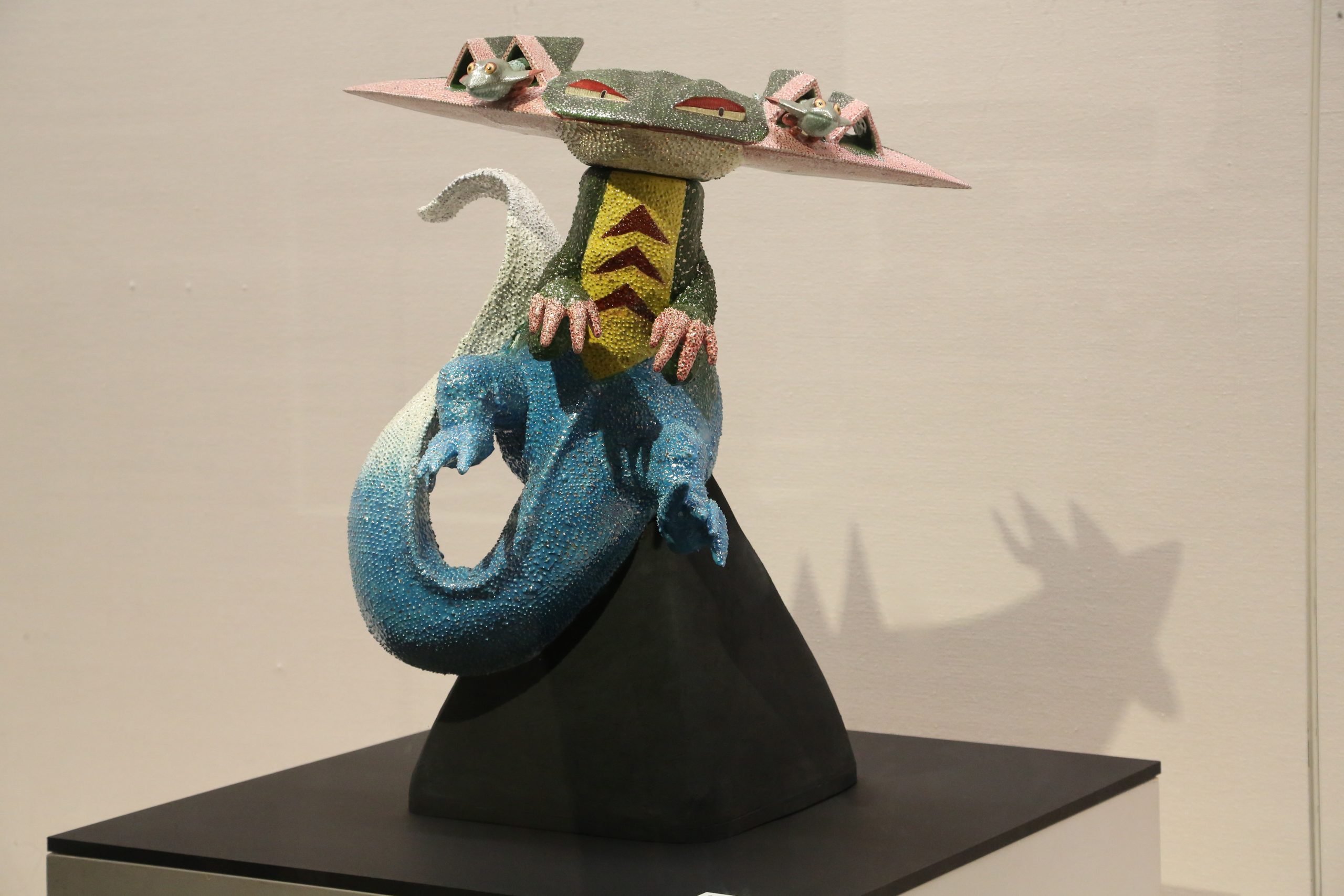
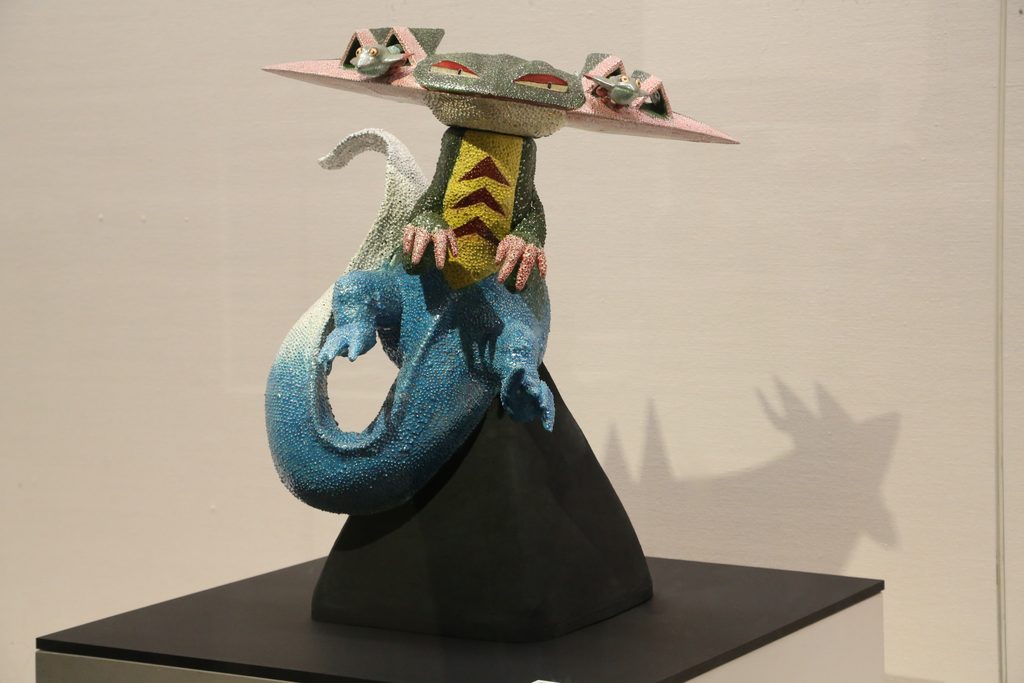
As we reach the end of the ceramics showcase in the first room, we are treated to a stunning addition that wasn’t part of the original exhibition’s launch. Perched majestically on a dark pedestal is the fan-favorite Dragon/Ghost-type Pokémon from Generation 8: Dragapult.
Created by the brilliant Kyoto ceramicist Sadamasa Imai, this piece perfectly bridges the gap between ancient Japanese pottery and modern, sleek character design. What makes this display truly magical is not just the sculpture itself, but the eerie, beautiful shadow it casts onto the gallery wall—a perfect nod to its Ghost-type nature.
A Stealth Bomber Brought to Life in Clay
Dragapult’s design is heavily inspired by prehistoric amphibians and modern stealth aircraft. Replicating that razor-thin, flat, triangular head in heavy ceramic clay is an absolute technical nightmare.
If the clay is even slightly too thick, it will warp or shatter in the high-heat kiln. Yet, Imai executed the sharp, geometric lines of Dragapult’s head flawlessly, maintaining its aerodynamic and ghostly presence while grounding it entirely in the organic weight of clay.
The Fine Textures of a Phantom Reptile
Imai’s signature style is his obsessive study of real-world living creatures, which he applies to fictional Pokémon.
If you look closely at Dragapult’s skin, it features an incredible gradient of textures. The lower blue body has a wet, smooth reptilian sheen, while its belly sports vibrant yellow patterns. The tiny claws on its hands and tail look delicate yet sharp, making the Pokémon feel less like a digital sprite and more like a real, rare reptile you might discover deep inside a hidden cave.
Don’t Forget the Dreepy!
A Dragapult isn’t complete without its favorite ammunition, and Imai didn’t forget them! Tucked snugly into the hollow launchpads on both sides of its head are two adorable, tiny Dreepy (ドラメシヤ).
Even at such a microscopic scale, these tiny dragon spirits have distinct, curious expressions on their faces. The amount of patience required to sculpt and glaze these minute details by hand is exactly what makes Japanese “Kogei” craftsmanship so revered around the globe.
Outro
Standing in front of this sculpture at the Hiroshima Prefectural Art Museum, the contrast between the vibrant, colored glazes and the stealthy silhouette was unforgettable. Imai took a modern, complex design and proved that centuries-old pottery techniques are still the perfect medium to capture the soul of imagination. [1]
How do you feel about this ceramic, “alive” take on the phantom dragon? Let me know your thoughts in the comments below!