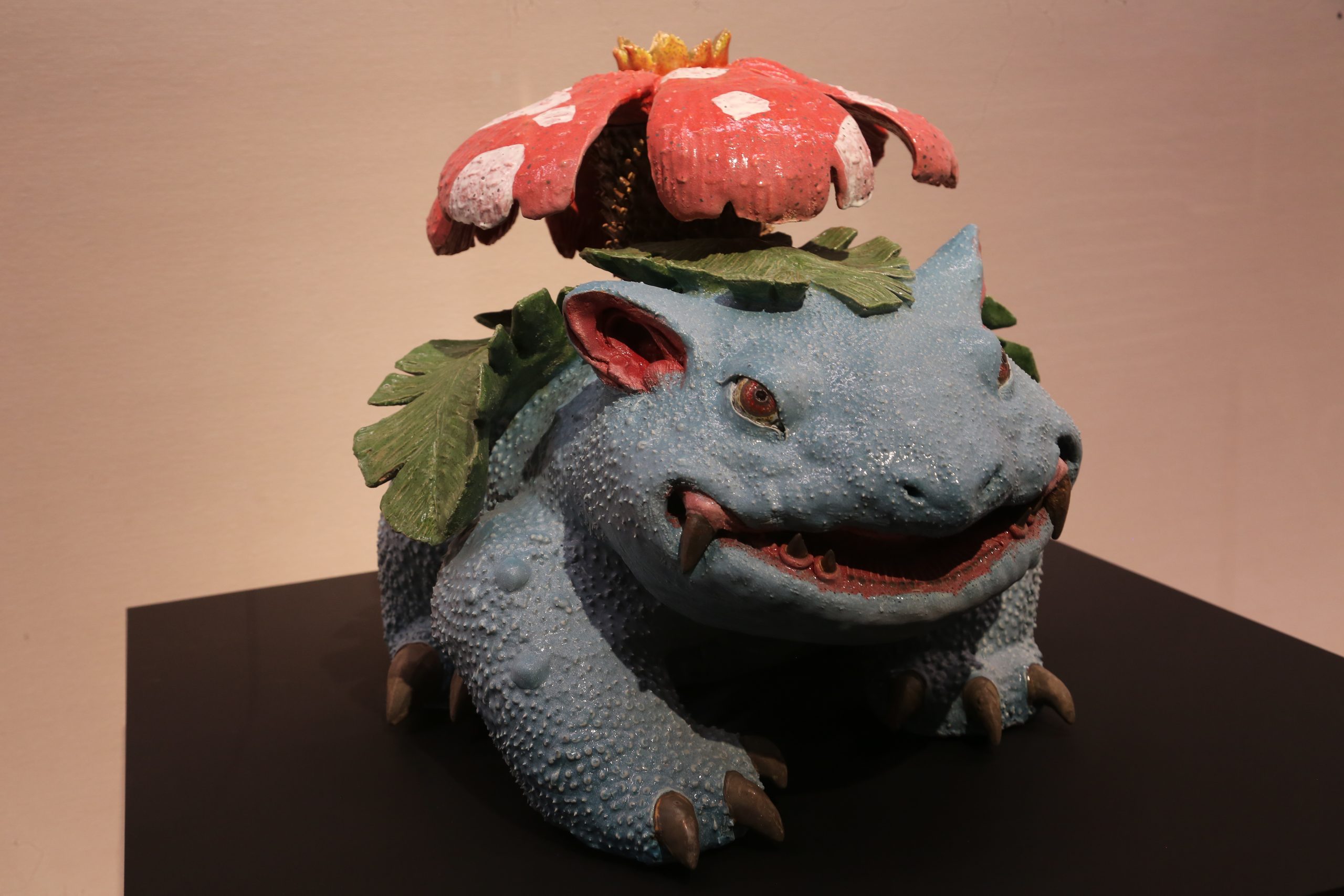
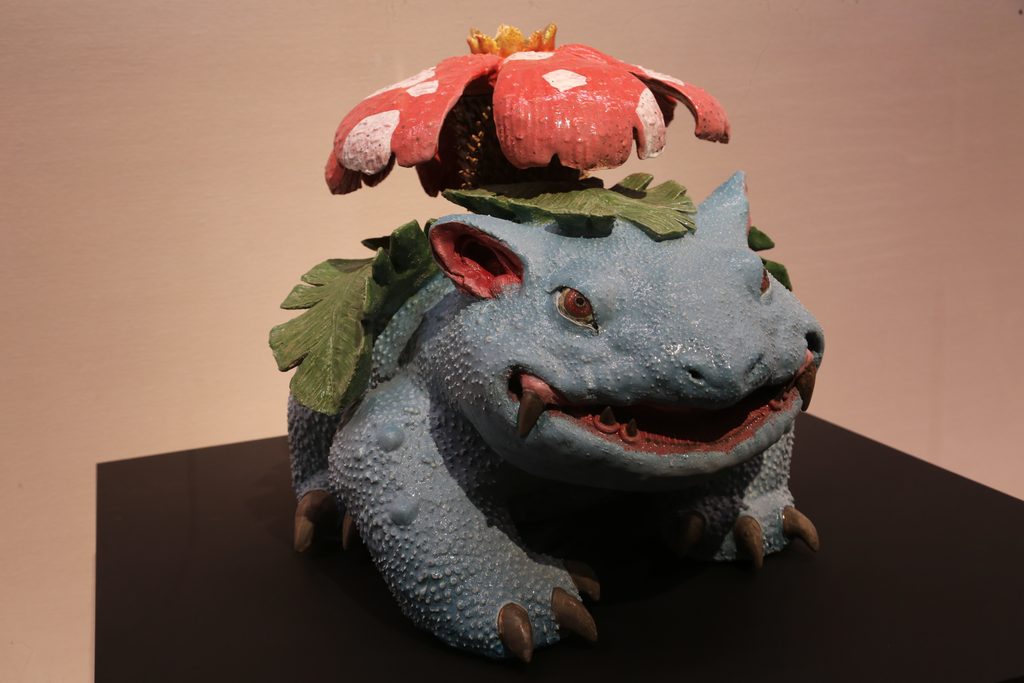
Moving further into the opening section of the exhibition, you are suddenly greeted by a massive, commanding presence. Resting heavily on its pedestal is one of the most iconic Generation 1 Pokémon of all time: Venusaur.
Sculpted by Sadamasa Imai, a renowned ceramic artist from a three-generation pottery family in Kyoto, this masterpiece brings a raw, prehistoric energy to the Pokémon that you can practically feel through the glass.
The Texture of a Living Creature: The “Itchin” Technique
When you look at this Venusaur up close, the first thing that strikes you is its skin. It isn’t smooth like plastic; instead, it is covered in thousands of realistic, bumpy warts that make it look like a real amphibian or dinosaur.
To achieve this incredible texture, Imai used a traditional Japanese pottery technique called “Itchin” (イッチン – Slip Trailing). This involves placing liquid clay inside a squeeze tube (similar to piping icing onto a cake) and painstakingly applying thousands of tiny dots directly onto the creature’s body. The result is a tactile, hyper-detailed skin that perfectly matches Venusaur’s thick, rugged hide.
Masterful Hand-Building (手びねり – Tebineri)
Instead of using a pottery wheel or a pre-made mold, Imai sculpted this heavy Venusaur entirely by hand using the “Tebineri” (Hand-building/Coiling) method. He pinched, shaped, and layered the clay by hand, allowing the natural weight and imperfections of the earth to give Venusaur its powerful, low-slung, and muscular stance.
The fierce glare in its eyes and the sharp teeth jutting from its jaw make it look less like a cartoon character and more like a legendary beast of nature.
The Blooming Flower and Earthy Glazes
The massive flower blooming on Venusaur’s back is also a triumph of ceramic engineering. Firing large, heavy, and intricately spread-out petals in a kiln is notoriously difficult, as the clay can easily crack or warp under intense heat.
However, the rich, matte red of the petals and the deep green of the leaves are beautifully preserved. The subtle, slightly glossy sheen on the blue skin gives it an organic, wet texture, contrasting beautifully with the dry, earthy feel of the tropical bloom on its back.
Outro
Imai’s Venusaur feels incredibly grounded because it is literally made from the earth itself. It shows how traditional Japanese ceramics can take a digital creature we’ve known for decades and give it a soul that feels thousands of years old.
Doesn’t this ceramic texture completely change how you picture a real-life Venusaur? Let me know your thoughts in the comments!