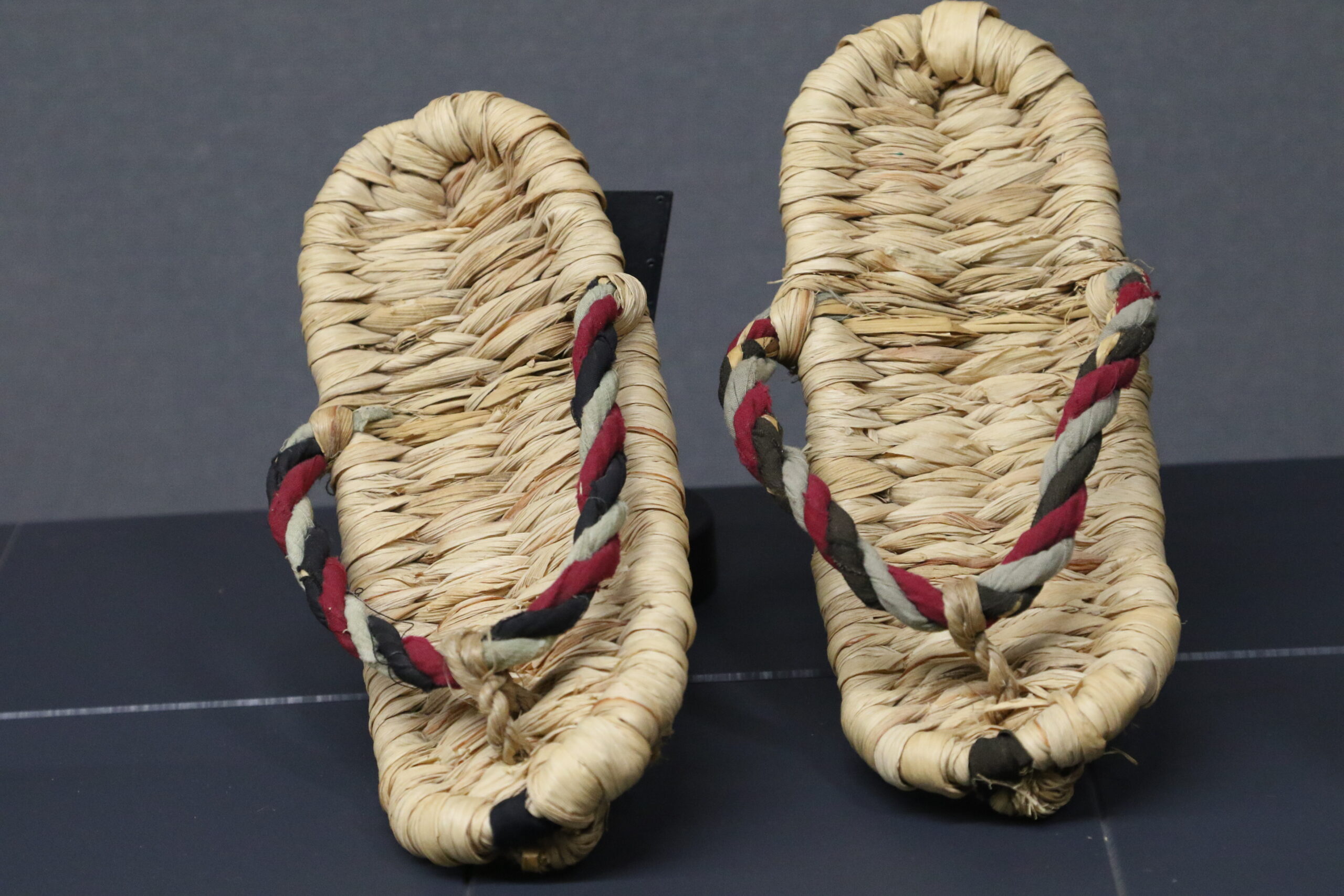
Modern shoes are industrial products.
Rubber is synthesized, foam is engineered, leather is globally traded, and design is standardized.
But for most of Japanese history, footwear did not come from factories.
It came from the field.
From the forest.
From the wetlands.
You wore what grew around you.
This was not a romantic ideal. It was a practical reality shaped by geography, climate, and material intelligence. In agrarian Japan, people crafted sandals from the plants that defined their landscape. The land quite literally shaped the sole.
In this third installment of our Japanese footwear series, we look at three remarkable examples of plant-based sandals—each made from a different local material:
- Corn husk
- Bamboo shoot sheath
- Cattail stem
Each tells a story about environment, resourcefulness, and how necessity becomes design.
1. Corn Husk Sandals — Flexible Strength from the Field
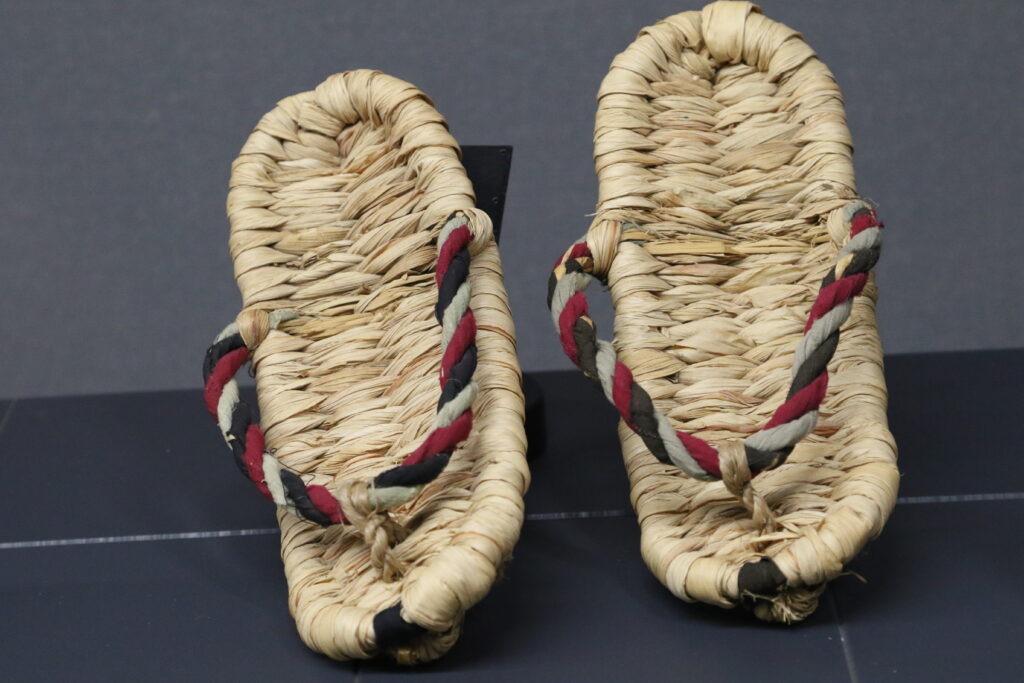
At first glance, corn husk might seem like an unlikely material for footwear. It is thin, soft, and typically discarded after harvest.
Yet when dried and braided, corn husk becomes surprisingly resilient. Its natural flexibility allows it to conform gently to the foot, reducing friction and improving comfort over long hours of walking.
Corn (introduced to Japan in the early modern period) quickly became integrated into rural agriculture. And like many aspects of Japanese material culture, nothing went to waste. Once the edible part was harvested, the outer husk remained—lightweight, fibrous, and workable.
Farmers braided these husks into sandals similar in structure to waraji. The result was:
- Lightweight
- Breathable
- Moderately durable
- Adaptable to agricultural work
Unlike wooden geta, which elevate the foot, these sandals connected the wearer directly to the earth. The material came from the field, and it returned to the soil when worn out.
There was no synthetic residue. No industrial footprint.
Just plant fiber, shaped by hand, used, and eventually decomposed.
This is circular design centuries before the term existed.
2. Bamboo Shoot Sheath Sandals — Engineering from the Forest
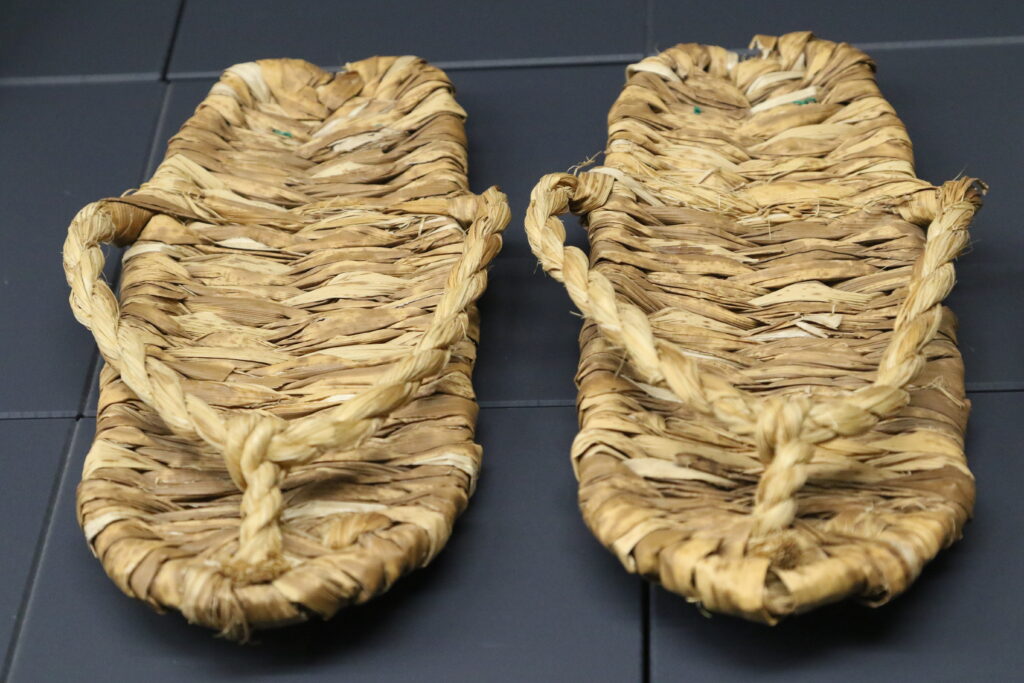
If corn husk represents the field, bamboo represents the forest.
Bamboo is one of the most important materials in Japanese history. It is architecture, tool-making material, fencing, baskets—and in some regions, even footwear.
The outer sheath of bamboo shoots (particularly from species such as madake) is strong along its vertical fibers. When dried and woven, it produces a tougher, more structured sandal compared to corn husk.
Unlike softer agricultural fibers, bamboo sheath has a distinct tensile integrity. It resists tearing and maintains form under repeated stress. This makes it suitable for:
- Everyday walking
- Indoor use
- Light labor
Historical examples show that some bamboo-based footwear was even used as indoor slippers. This demonstrates an important principle: material selection followed function.
Where bamboo forests were abundant, communities leveraged what was accessible. The plant that framed houses and held up ceilings could also support the human body in motion.
This is not accidental craftsmanship.
It is environmental logic.
Bamboo grows rapidly. It regenerates. It requires no industrial processing. Its use in footwear is a continuation of a broader material ecosystem in which the forest supplied nearly everything necessary for daily life.
When we speak of “sustainable materials” today, bamboo is often marketed as innovative. But in Japan, its application in daily objects—including sandals—reflects an older, embedded knowledge system.
3. Cattail Stem Sandals — Designed by Wetlands
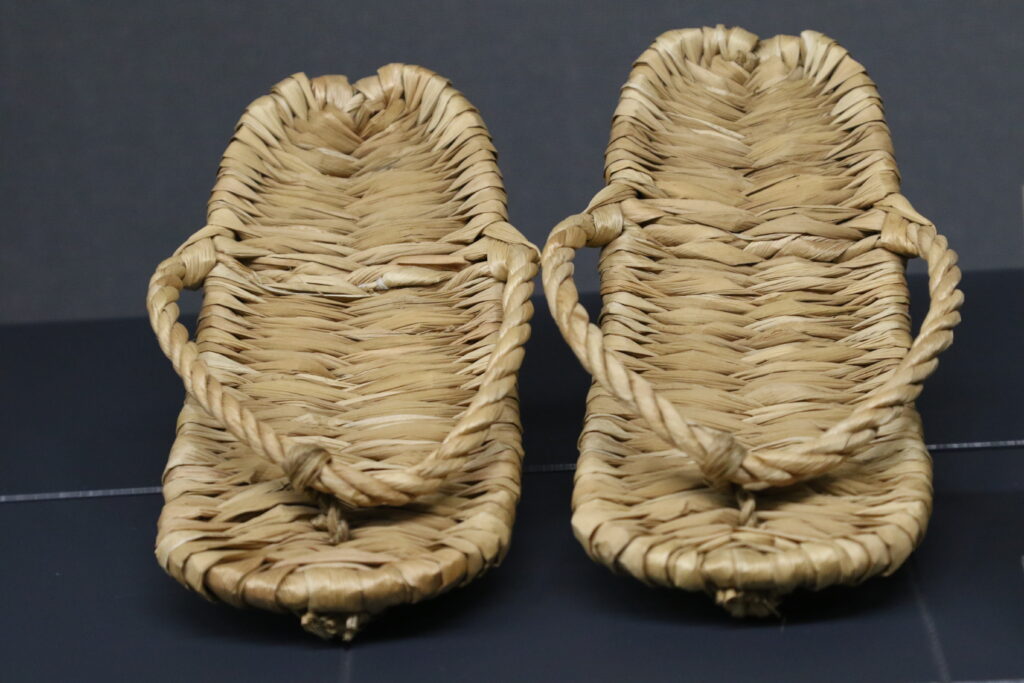
Move from field and forest to water.
Cattail (gama in Japanese) thrives in wetlands, riverbanks, and rice paddies. Its long, fibrous stems have natural water-resistant properties.
In regions defined by rice cultivation—where mud and standing water are part of everyday life—footwear had to accommodate moisture.
Cattail fibers, when bundled and woven, produce sandals that:
- Resist saturation
- Dry relatively quickly
- Maintain structure in damp conditions
This is geography shaping design.
Rice agriculture dominates much of Japan’s historical landscape. Working in paddies demands footwear that does not collapse in mud. Leather would rot. Wood would slip. But plant stems that evolved in wetlands are inherently adapted to moisture.
The choice of cattail was not aesthetic. It was biomechanical and environmental.
These sandals represent adaptive design long before industrial waterproofing existed.
The plant that grew in the water supported the people who worked in it.
Land as Designer
Across these three examples—corn husk, bamboo sheath, cattail stem—we see a pattern:
- Agricultural plains produced soft, flexible materials.
- Forest regions produced strong, structured fibers.
- Wetlands produced water-resistant stems.
The environment dictated available resources. Those resources dictated construction techniques. Those techniques defined daily life.
Traditional Japanese footwear was not designed in isolation from nature. It was designed within it.
In a modern framework, we might call this:
- Local sourcing
- Zero-waste manufacturing
- Biodegradable materials
- Climate-adaptive design
But historically, it was simply common sense.
Transportation was limited. Trade networks existed, but rural communities relied primarily on what was accessible. Material literacy—understanding how plants behave when dried, twisted, braided, or layered—was a form of survival knowledge.
Footwear was not fashion in the contemporary sense. It was infrastructure.
The Intelligence of Impermanence
One striking characteristic of plant-based sandals is their impermanence.
They wear down quickly compared to leather or rubber shoes. But this was understood and accepted.
Sandals were:
- Repairable
- Replaceable
- Compostable
The expectation was not permanence, but renewal.
In contrast, modern footwear is engineered for durability yet often discarded due to style shifts rather than structural failure. Synthetic soles outlast trends but persist in landfills.
Plant sandals returned to the soil.
Their lifecycle mirrored agricultural cycles: growth, harvest, use, decay.
This reflects a broader Japanese cultural sensitivity toward transience—an awareness that objects need not last forever to be meaningful.
Tactile Connection
There is also a bodily dimension.
Plant fiber sandals are thin. They allow the wearer to feel the ground—its temperature, texture, and irregularity. This tactile feedback influences posture and gait.
Unlike cushioned modern sneakers, which isolate the foot from terrain, traditional sandals maintain connection.
The body responds to the land.
In that sense, footwear was not just protection—it was mediation between human and environment.
Why This Matters Today
Revisiting these plant-based sandals is not about nostalgia.
It raises a question:
What would footwear look like if it were once again shaped primarily by local ecology?
Globalized manufacturing has separated design from geography. The same sneaker model is sold in humid tropics and arid deserts. Materials are standardized; climate variation is secondary.
Traditional Japanese sandals suggest another possibility:
Design that begins with place.
Not imported raw materials.
Not synthetic composites.
But what grows nearby.
In an era of climate anxiety and supply chain instability, this philosophy feels newly relevant.
Walking on What Grows Beneath You
The third chapter of Japanese footwear history is not about elegance or status. It is about adaptation.
Corn husk from the field.
Bamboo sheath from the forest.
Cattail stem from the wetlands.
Each material tells us something about where people lived and how they moved.
The land shaped the sole.
And the sole carried the story of the land.
When we look at these sandals today, we are not simply looking at objects.
We are looking at geography woven into form.