Some images do not ask to be explained.
They simply ask to be seen.
This small Japanese picture book, created decades ago on fragile paper, is filled with soft, humorous figures—faces simplified to their essence, bodies moving as if caught mid-story. Time has stained the pages, but instead of weakening the images, it has given them depth.
Here, I present three images only.
No more are needed.
1. The Open Book: A World in Motion
The first image shows the book opened wide.
Multiple scenes coexist on a single spread: walking, resting, dancing, watching. The characters reappear in different poses, suggesting continuity rather than sequence. It feels less like reading a story and more like entering a town where everyone is already living their lives.
The drawings are modest in scale, but confident in rhythm. The repetition of faces creates familiarity, while small variations keep the eye moving.
This image establishes the world.
2. A Single Scene: Completion Without Excess
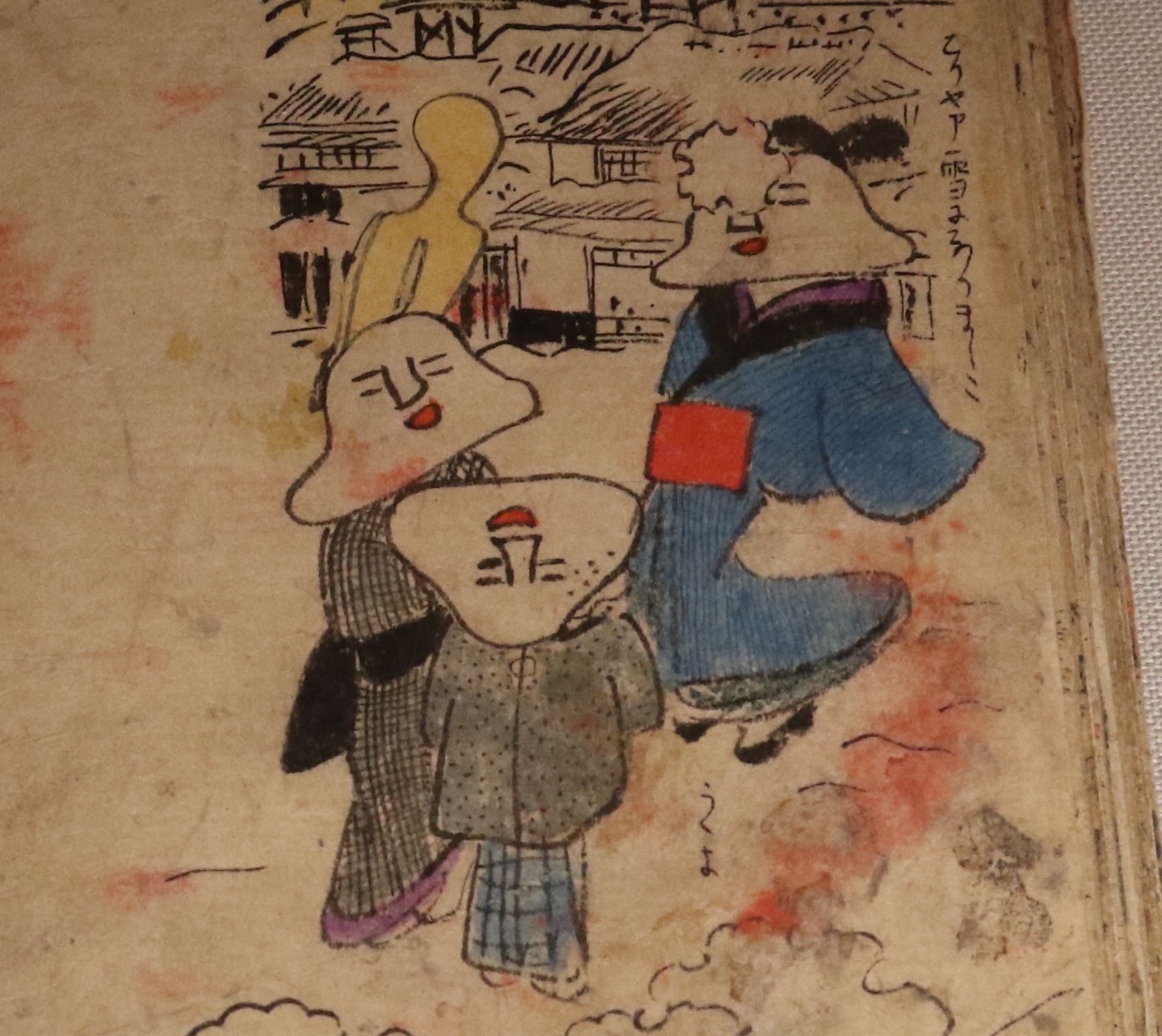
The second image isolates one scene from the book.
Three figures walk together. Their expressions are minimal, yet unmistakably expressive. Clothing patterns are carefully differentiated, and color is applied with restraint. The background is suggested, not described.
Nothing here feels unfinished.
Nothing feels overworked.
This scene does not demand continuation. It is complete as it is—quietly balanced, gently humorous.
3. From Page to Space: Contemporary Presence
The third image shows these characters enlarged and displayed in an exhibition space.
Once confined to fragile paper, they now exist at human scale. They step into the viewer’s world, not as historical artifacts, but as living forms.
This transformation confirms something important:
these figures are not bound to their time or medium.
They remain readable, approachable, and strangely familiar.
Conclusion
Three images are enough.
One shows the world.
One shows the essence.
One shows the present.
Anything more would explain too much.
These images prefer to remain open—inviting viewers to complete the story themselves.