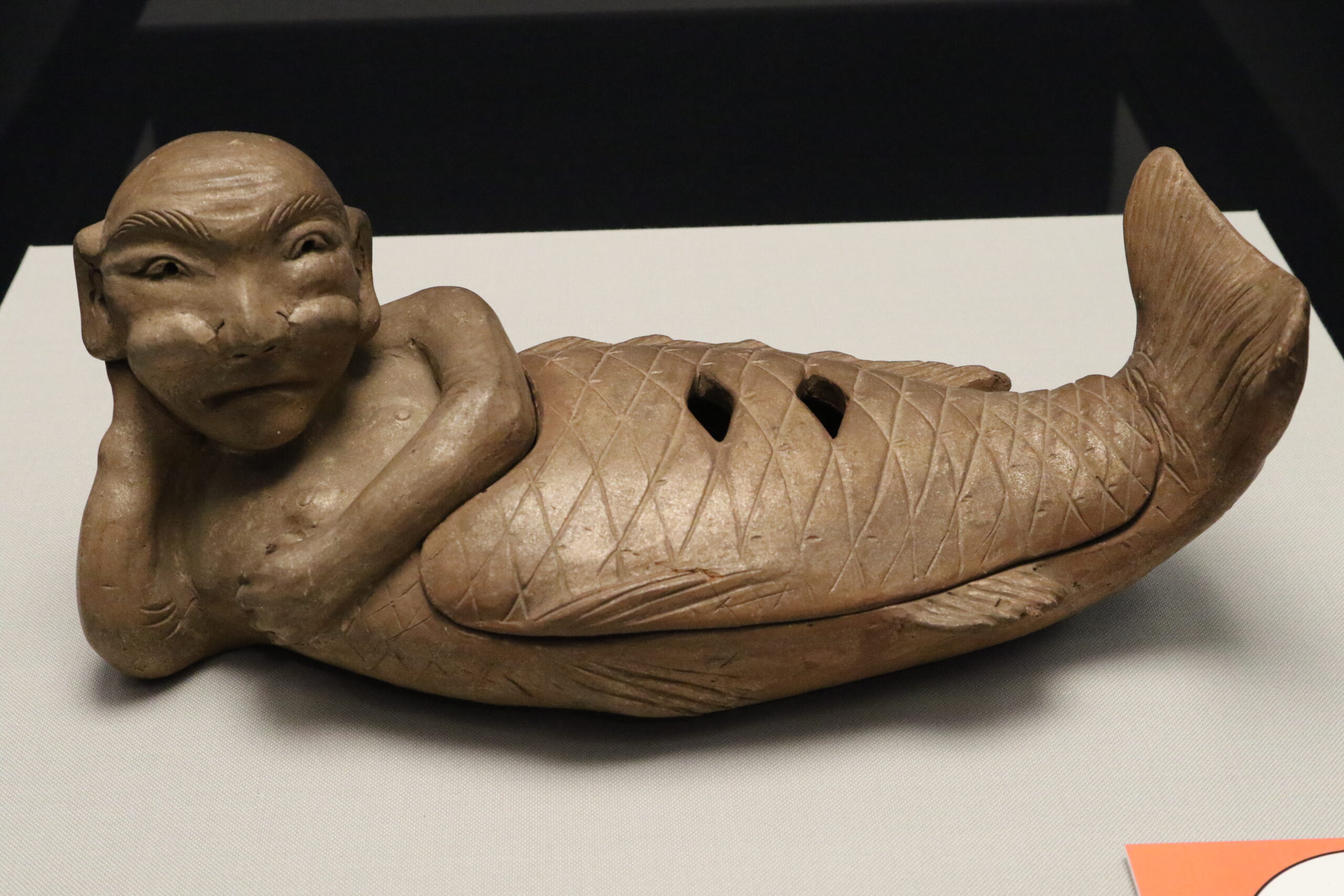
An Old Man Mermaid Preserved as a Ceremonial Dish, Once Kept by a Kyoto Family
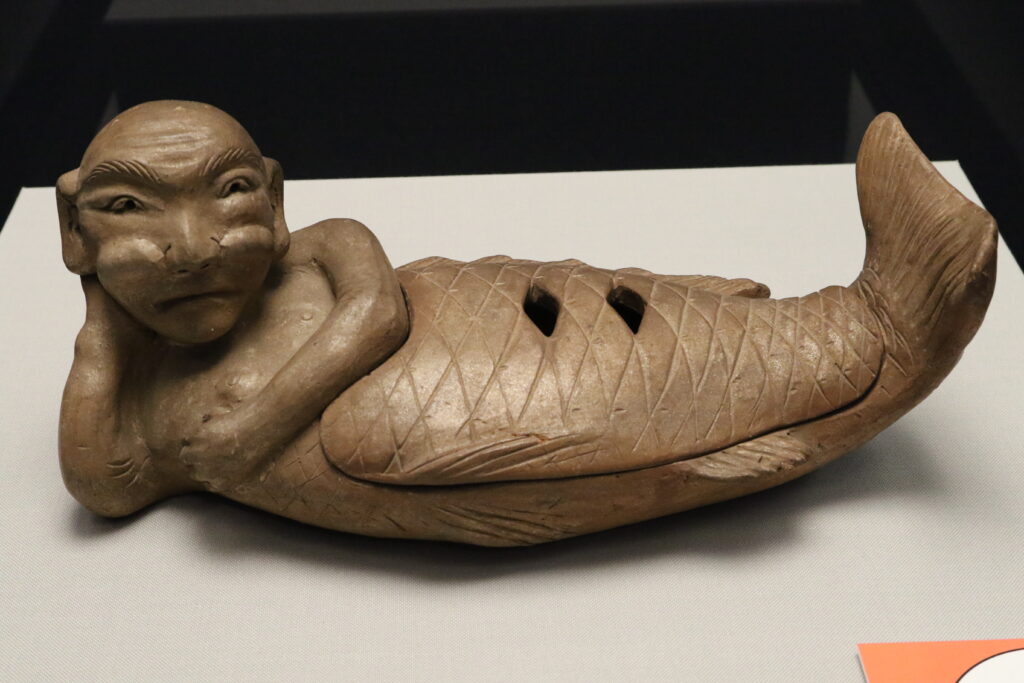
This is not the mermaid most people imagine.
In Japan, mermaids were never symbols of beauty or romance.
This unsettling figure—an old man’s face fused with a fish’s body—was once preserved by an old family in Kyoto and used during celebrations of long life.
According to a legend passed down across Japan, a young woman who ate the flesh of a mermaid would gain immortality and eternal youth.
This article explores the strange story behind this “old man mermaid,” why such an object existed, and what it reveals about how ancient Ja
The Legend Behind the Old Man Mermaid
According to tradition, this strange mermaid-shaped dish was once kept by an old family in Kyoto.
It was not displayed as a curiosity, but preserved as part of a story deeply connected to longevity and ritual.
Across Japan, a belief spread that the flesh of a mermaid possessed extraordinary power.
If eaten—especially by a young woman—it was said to grant eternal youth and immortality.
In many versions of the story, the mermaid’s flesh is served unknowingly at a banquet.
The girl who eats it does not age.
Years pass, then decades, then centuries.
Everyone she loves grows old and dies, while she remains unchanged.
What begins as a blessing slowly turns into a burden.
A Story That Traveled the Entire Country
This legend did not remain confined to Kyoto.
Over time, it evolved into one of Japan’s most famous folklore tales: the story of Yao Bikuni, the Eight-Hundred-Year Nun.
In this version, the immortal woman eventually abandons ordinary life, becomes a nun, and wanders the country before disappearing.
What is remarkable is not only the story itself, but how widely it spread.
From coastal villages to inland regions, the idea that a mermaid could grant life beyond human limits became deeply rooted in local belief.
The Kyoto mermaid dish stands at the crossroads of these traditions—
not as proof that mermaids were eaten, but as evidence that people believed the story strongly enough to ritualize it.
Immortality Was Never a Simple Wish
In Japanese folklore, eternal life is rarely portrayed as joyful.
Instead, it is often shown as isolating, sorrowful, and unnatural.
The old man’s face on this mermaid may reflect that worldview—a reminder that living forever means carrying endless time, memory, and loss.
This is not the promise of youth.
It is a warning about what happens when humans cross the boundary meant for gods and spirits.
From Immortality to Protection: Mermaids on Japanese Roofs
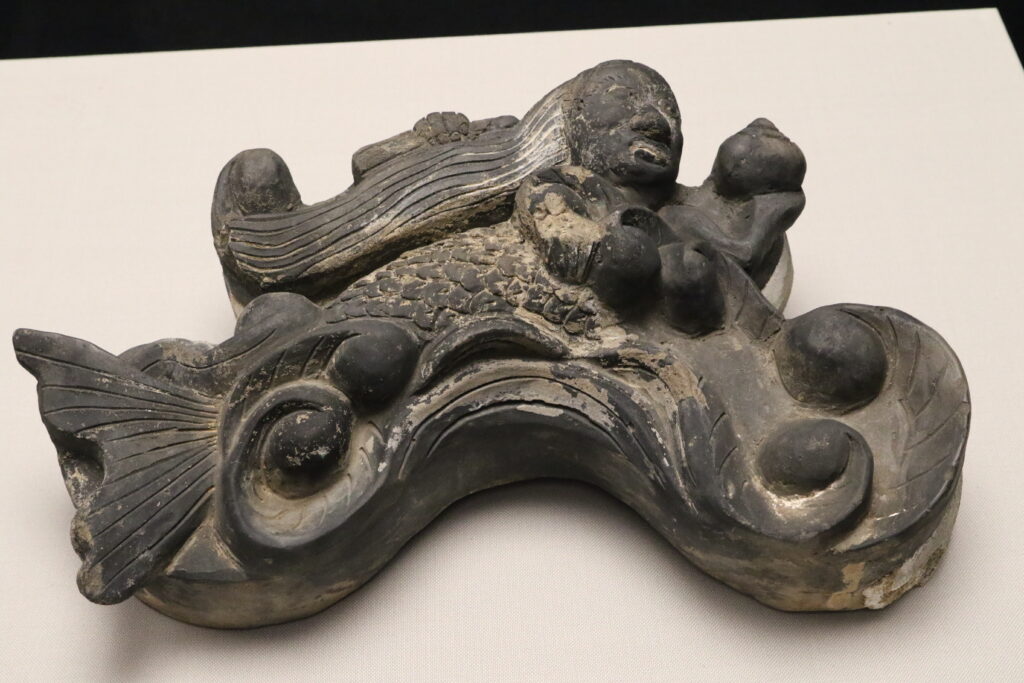
At first glance, the idea may seem surprising.
Why would a creature associated with immortality and forbidden flesh appear on the roof of a building?
Yet across parts of Japan, mermaid-shaped roof tiles—often classified as onigawara (decorative ridge-end tiles)—were created and installed on temples, shrines, and private buildings.
These were not decorative fantasies.
They were believed to serve a protective function.
Why Mermaids Were Placed on Roofs
In traditional Japanese belief, the ningyo (mermaid) was a deeply ambivalent being.
It was associated not only with long life, but also with calamity, disease, and unnatural forces.
Seeing a mermaid was often considered an omen—sometimes of disaster, sometimes of transformation.
Because of this dangerous power, mermaids were thought capable of repelling even greater threats.
Placing a mermaid figure on a roof was a way to harness that power.
Just as oni masks, shachihoko, and other mythical beings were used to guard buildings,
the mermaid became a boundary guardian, positioned at the edge between the human world and the sky.
A Belief Made Visible
Unlike stories passed down orally, roof tiles are physical evidence.
They show that belief in mermaids was not limited to folklore or ritual banquets,
but extended into everyday life and architecture.
The same creature that could grant immortality through its flesh
was also believed to protect homes, communities, and sacred spaces from harm.
This dual role reveals something essential about Japanese folklore:
supernatural beings are rarely purely good or evil.
They are forces to be respected, feared, and carefully controlled.
From the Table to the Rooftop
Seen together, the Kyoto mermaid dish and the mermaid roof tile tell a single story.
One belonged to the intimate world of ritual and storytelling.
The other stood openly, visible to all, guarding from above.
Both reflect the same idea:
immortality, when taken lightly, becomes dangerous—
but when acknowledged and contained, it can protect rather than destroy.
Conclusion: A Mermaid That Was Never Meant to Be Beautiful
The old man mermaid of Kyoto was never meant to be admired.
Its unsettling face, aged and weary, stands in stark contrast to the youthful, romantic mermaids of Western imagination.
And that contrast is precisely the point.
In Japanese folklore, immortality is not a simple gift.
It is a force that isolates, burdens, and disrupts the natural order.
The stories of mermaid flesh, the wandering life of Yao Bikuni, and the presence of mermaids on rooftops all reflect the same belief:
living forever comes at a cost.
The mermaid-shaped dish reminds us of rituals and stories shared in intimate spaces, where myths were passed down through generations.
The mermaid roof tile shows how those beliefs extended outward, becoming part of architecture and daily life.
Together, they reveal a worldview in which supernatural beings were neither purely benevolent nor purely evil.
They were powers to be acknowledged, respected, and carefully contained.
Seen in this light, the old man mermaid is not grotesque.
It is honest.
It shows immortality not as eternal youth, but as endless time—etched onto a human face that has simply lived too long.